
Do you know your resilience starting blocks?
The word resilience gets bandied around a lot, particularly as an answer to employee burnout and enabling high performance in the workplace. But what actually is it?

Given the number of difficulties work and life can throw at us, it is easy to see why resilience is useful. Difficulties are wide-ranging in nature. They can be one-off events (e.g., dropping a milk carton or not getting an expected promotion, which are termed acute stressors. Alternatively, difficulties can also be long enduring in nature (e.g., caring for a parent with a long-standing illness or a continual high workload without rest and recovery). These are termed chronic stressors. An organisation’s systemic issues are often chronic stressors.
It is the exposure to chronic stressors that can wear employees down and impact their physical, mental and emotional health. This happens through a concept known as “allostatic load”, a term coined by Bruce McEwan and Eliot Stellar in 1993. It refers to the cumulative burden of adapting to stress. Let’s unpack that a little before coming to where resilience fits in with allostatic load.
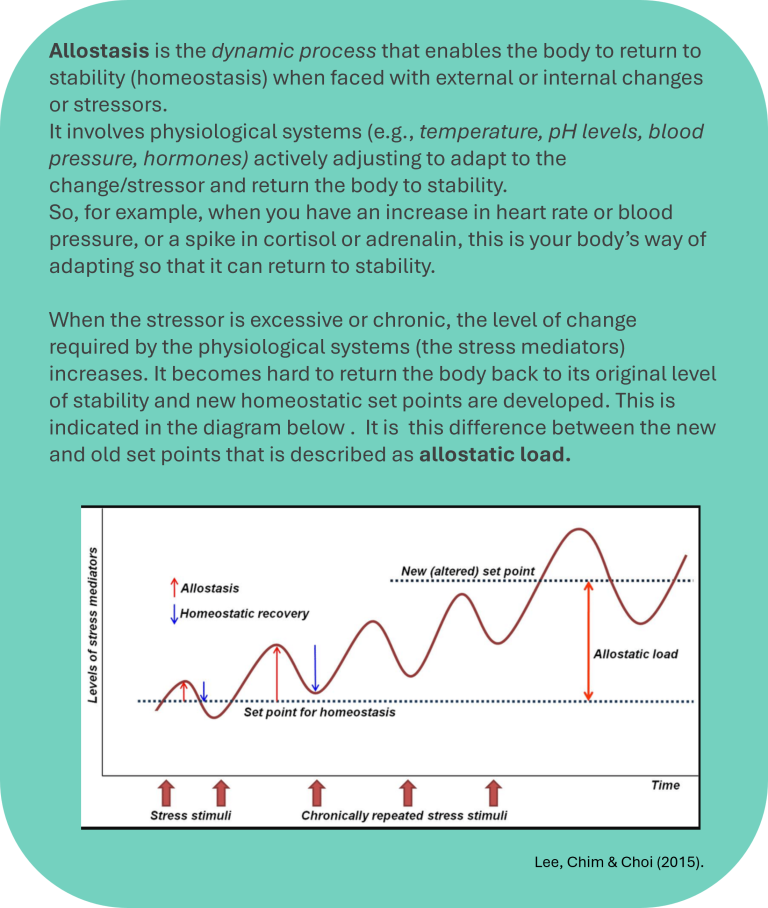
The excessive use of stress mediators (e.g., blood pressure, hormones) can lead to cardiovascular conditions, hormonal imbalance, sleep and mood disorders, anxiety, emotional reactivity and cognitive decline. Indeed, McEwan has described allostatic load as “the price people pay for adapting to stress”.
What does resilience have to do with this?
Resilience can help to buffer against the excessive or chronic use of stress mediators, returning our body to original levels of stability and allowing us to keep peforming optimally through adversity. So, whilst it is a very useful ingredient in workplace performance, it is a critical ingredient for our health.
Is resilience something we can develop?
Neuroplasticity tells us that the brain is not fixed, and we can create and strengthen new neural pathways through deliberate practice. So, yes – we can develop resilience.
The science so far suggests our capacity for resilience is influenced by genetics and our early life experiences. As a result, some people are more hopeful or optimistic or have higher self-efficacy (belief in our own ability) or more positive affect (joy, enthusiasm, energy) – all qualities which enable resilience. If we don’t have bucket loads of these naturally, we are not doomed!
All it means is that we all have our own unique starting blocks from which we can strengthen our resilience.

In the field of resilience science, a debate continues on the definition of resilience; for example, some say it is a process, others say it is an outcome (Southwick et al, 2014). We take the approach that resilience is the result of a dynamic process between resilience resources and resilience mechanisms, enabling growth from adversity.
Resilience resources include (1) personal characteristics (such as optimism, self-compassion, hope, positive affect), (2) social support (such as strong supportive relationships or communities), (3) skills (e.g., moment-to moment awareness, learned hopefulness, self-compassion, somatic awareness, developing an internal locus of control), and (4) living in alignment with values.
Resilience mechanisms include (1) effective (adaptive) coping strategies, which can be both problem-focussed and emotion-focussed, (2) positive cognitive appraisal which enables a more skilful interpretation of and response to stressors, (3) integrating the stressor (i.e., making meaning from the difficulty or accommodating it alongside existing beliefs and values), and (4) self-regulation, which is the managing of ones emotions, thoughts and behaviours in response to the stressor.
Finding Optimum Resilience programmes integrate all the elements above in a framework of prepare, manage and grow (see below). Participants develop resources to protect themselves and learn effective strategies and skills to employ during difficulty.
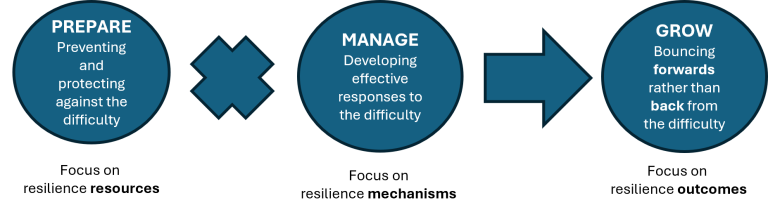
The Finding Optimum Resilience Framework
But what about the organisation’s role and responsibility?
My standpoint is identical to that in my post on workplace wellbeing programmes. A one-off resilience programme is like a plaster. The organisation has a major role to play in protecting against stress AND in enabling resilience.
What is the organisation putting in place to protect an employee’s resilience resources? For example, are they integrating recovery cycles for employees?
Does the social architecture and culture of the organisation encourage sharing? For example, are mistakes viewed as problematic or learning opportunities?
If your organisation is interested in taking a more systemic approach to resilience or you are interested in the Finding Optimum Resilience programme, please do get in contact.
© Anne Macdonald, 2025